From single channel to omnichannel: digital marketing channels and a connected customer journey
Majid Riazi · Digital marketing strategy and omnichannel marketing
Not long ago, one channel could provide enough reach: a well-positioned shop, outdoor advertising or a website. Customer behavior has changed. Someone may discover a brand on Instagram, research it on Google, complete a website inquiry, talk to sales on WhatsApp and finally buy in person.
Does the business recognize the same customer across that journey? When the visitor becomes a lead, do sales and other marketing systems know? After purchase, do acquisition advertisements continue promoting the same offer? Can information supplied in one channel be used appropriately in another?
The answers distinguish simply having several channels from genuine omnichannel coordination. This article moves from single and multichannel to cross-channel and omnichannel, then considers unified and agentic commerce.
What are digital marketing channels?
A channel is a pathway or environment through which a business communicates, conveys marketing messages, attracts prospects or supports sales and retention. Different components play different roles:
- SEO and organic search: reach people searching for information, services and products.
- Search advertising: attract targeted paid traffic.
- Social networks: build awareness, interaction and demand.
- Content marketing: educate, build trust and support decisions.
- Email: nurture leads, maintain relationships and encourage repeat purchases.
- SMS: send operational updates and targeted offers.
- Messaging platforms: enable direct discussion, support and sales follow-up.
- Websites and apps: provide information, capture inquiries and complete transactions.
- Display advertising and retargeting: re-engage previous visitors and audiences.
These are not identical technical categories: SEO is an acquisition method, a website is an asset and content marketing is an approach. They are nevertheless often considered together when designing the communication ecosystem.
Channel count alone does not measure digital maturity. Ten disconnected channels can perform worse than three coordinated ones with a stronger customer experience.
1. Single channel
A single-channel business relies mainly on one environment for marketing, communication and sales. An Instagram retailer, for example, introduces products, answers questions and accepts orders there.
Advantages include focused resources, straightforward management and measurement, lower initial operating costs and expertise in one platform. The weakness is dependency: algorithm changes, rising advertising costs or access restrictions can disrupt customer relationships. Customers also prefer different contact methods. Single channel can suit an early-stage business, but its limitations become more apparent as the market expands.
2. Multichannel
A multichannel business uses several touchpoints—perhaps a website, Instagram, Telegram, Google Ads and SMS—to reach more people. Multiple channels do not necessarily share information or processes.
The social team may not know about website activity; sales may not know a prospect came from an advertisement; SMS campaigns may not know the person has purchased. Someone can complete a consultation form and still receive repeated “register for a consultation” ads because advertising and lead management are not effectively coordinated.
Multichannel reduces reliance on a single source and increases reach. It also adds management cost, fragments information and makes channel contributions harder to interpret. More access does not automatically create a connected experience.
3. Cross-channel
Cross-channel introduces purposeful coordination between certain channels. A customer discovers a product on Instagram, visits the website, adds it to a cart and receives an email reminder if the order remains incomplete.
Several channels now participate in one designed process. The connection may still be limited to a campaign, a specific journey or a few systems rather than every interaction. Definitions of cross-channel and omnichannel vary; they are not universally standardized, separate maturity stages.
4. Omnichannel
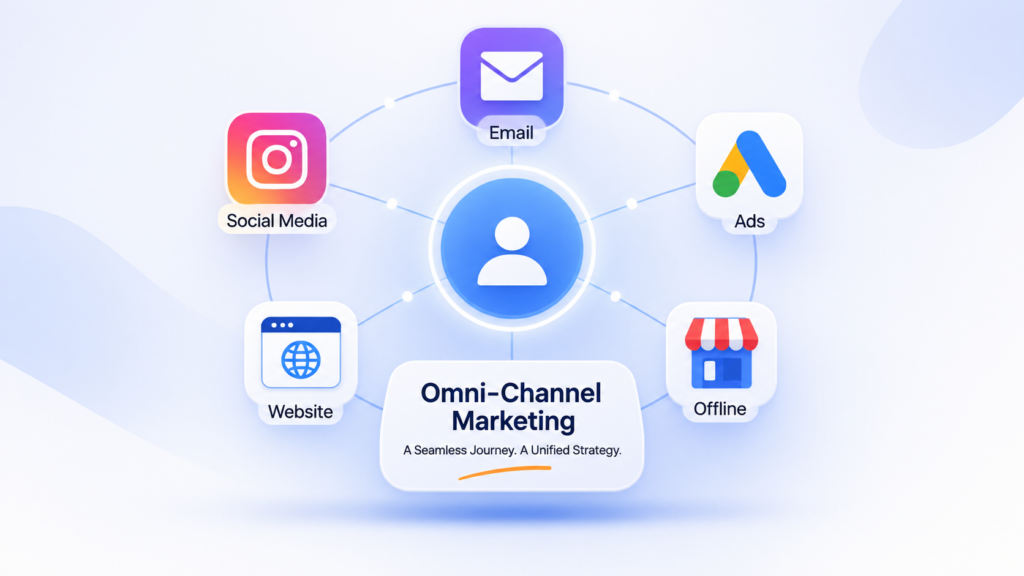
Omnichannel is a customer-centered approach aiming for continuity, coordination and traceability across relevant channels. The customer and the journey—not the channel—become the design’s center.
Multichannel asks where the business should be present. Omnichannel asks where the customer is in the journey and how to support the next step through the right channel without unnecessary interruption.
Continuity matters more than matching visuals
Consistent messages, tone and branding help but are insufficient. Marketing and sales processes should continue when the person moves between channels. If a visitor becomes a lead, relevant systems should recognize the change; if that lead buys elsewhere, the purchase should inform subsequent activity. This is customer-journey continuity.
A complete example
A service company uses Instagram, Google, its website, email and WhatsApp:
- Awareness: someone sees an Instagram video advertisement but is not yet a customer and may know little about the service.
- Consideration: days later, the person searches Google and arrives through organic results. Suitable measurement and identification may connect this activity with earlier interactions. Cross-device and cross-channel identification is not always possible; reliable identifiers, consent and privacy constraints matter.
- Lead generation: the person submits a consultation form. Their status changes from Visitor to Lead. Record it in the CRM and, where possible and permitted, pass the appropriate event to measurement and advertising systems.
- Different marketing behavior: instead of repeatedly asking for the same form, show relevant service information, project examples or collaboration benefits. The person may be excluded from some lead-acquisition campaigns. This requires correct CRM integration and audience updates; accuracy and speed vary by platform.
- Customer conversion: sales contacts the lead by WhatsApp or telephone and closes a contract. CRM status changes from Lead to Customer, and relevant systems should receive that update.
- Post-purchase coordination: acquisition campaigns can exclude the buyer; email can provide onboarding; support can access purchase and communication history; retention or complementary offers can begin; reporting can connect the sale to earlier touchpoints where reliable data permits.
Customers should not have to repeat everything whenever they switch channels. Omnichannel connects decisions, data and processes, not simply platforms.
Comparing the models
| Model | Defining feature | Channel relationship |
|---|---|---|
| Single channel | Focus on one channel | Not applicable |
| Multichannel | Presence in several | May remain independent |
| Cross-channel | Coordinated specific journeys | Some channels connected |
| Omnichannel | Customer-journey continuity | Relevant data, status and actions coordinated |
The distinction concerns coordination, information transfer and experience management, not merely the number of channels.
Required foundations
Omnichannel cannot be achieved solely by hiring a social-media manager or buying advertising tools. It needs a data, technology and process architecture.
CRM
Maintain relevant lead, customer, opportunity and interaction records. Customer status can then inform other systems’ actions.
Measurement and events
GA4 and Google Tag Manager can help record service-page views, call-button clicks, consultation submissions, quotation requests and purchases. GTM alone is neither a CRM nor a customer-identity system. Shared identifiers, server-side data connections and sales integration may also be necessary.
Customer-data integration
Information often sits separately in CRM, website, sales and support systems. Connecting it within privacy requirements gives a fuller picture. Depending on scale, direct integrations, APIs, automation tools or a customer data platform may be suitable.
Marketing automation
Defined actions can respond to behavior and status. A consultation request starts lead nurturing; purchase ends that sequence and starts existing-customer communication; a suitable interval after purchase can trigger a relevant replenishment offer where communication permissions allow.
Team coordination
Technology cannot fully compensate for weak processes. If marketing only collects leads, sales fails to record outcomes and support cannot see histories, integration fails. Omnichannel is a management and process project as well as a technology project.
The consultant’s role
The task is not merely selecting advertising channels, but designing how channels work together toward business goals. A consultant should examine:
- Which channels create awareness and which generate leads?
- Which journeys lead to purchases?
- How do sales outcomes return to marketing systems?
- Are existing customers still targeted as new prospects?
- Are channels evaluated separately or also in terms of the whole journey?
Often the issue is not missing channels but missing connections. A company may spend heavily on SEO, advertising and social media without knowing what produces qualified inquiries and sales. More budget is not automatically the answer. Better CRM structure, conversion definitions, sales integration and journey design may improve decisions more meaningfully.
Omnichannel and attribution
If a customer sees Instagram advertising, visits through Google, receives an email and buys by telephone, which channel receives credit? Marketing attribution addresses this question.
Coordinated data helps, but omnichannel does not solve attribution by itself. Privacy constraints, multiple devices and incomplete records remain. Attribution models should be complemented, where appropriate, by approaches such as incrementality experiments.
5. Unified commerce
Unified commerce concerns deeper integration of commercial and operating systems. Omnichannel emphasizes a continuous experience; unified commerce seeks coordinated architecture and dependable data across sales, orders, inventory, customer records and payments.
Customers might check branch availability online, order on the website, collect in store and return through another route. Relevant operating systems must reflect those actions. Unified commerce is not an obligatory replacement for omnichannel; it is a complementary approach to the underlying infrastructure.
6. Agentic commerce
AI agents may, with permission and defined authority, perform parts of search, comparison, selection or purchasing on a customer’s behalf. Someone might ask an assistant to find and compare laptops for graphic-design work within a specified budget. More advanced implementations may complete parts of ordering or payment with approval.
Businesses may increasingly need reliable, structured information usable by agents as well as good human experiences. Agentic commerce is still developing, however, and is not a mandatory stage every business reaches after omnichannel.
Does every business need omnichannel?
No. Choose according to scale, customer behavior, finances, sales complexity and touchpoints. A small company may do very well with two managed channels, while a large organization with branches, sales teams and ecommerce needs deeper integration.
Consulting should identify the architecture appropriate to actual circumstances rather than impose the most complex technology.
A practical implementation path
- Identify all communication, advertising, sales and support channels.
- Map touchpoints from awareness through purchase and loyalty.
- Define relevant statuses, such as Visitor, Lead, Marketing Qualified Lead, Sales Qualified Lead and Customer.
- Design the data flow: where each change is recorded and which systems need to know.
- Connect CRM, website, measurement, automation and communication systems as required.
- Define messages, channels and actions for each stage.
- Measure lead-to-customer conversion, customer acquisition cost, customer lifetime value, response time and repeat purchasing.
Start with a few high-priority journeys, evaluate results and expand.
Common implementation mistakes
Adding channels without shared processes can increase complexity. Buying expensive CRM, CDP or automation software before defining the problem wastes resources. Focusing only on acquisition ignores support, loyalty and repeat purchases.
Poor-quality, duplicate or inappropriately collected customer data creates further problems when combined. Finally, isolated channel metrics can obscure their contributions to business outcomes. Evaluate the journey as well as its components.
From channel management to relationship management
The shift toward omnichannel reflects a change in attention from individual channels to customers, data and processes. AI and automation may improve behavioral analysis, coordination and personalization, but technology does not replace strategy.
Before selecting tools, understand the journey, the information created at each step and how the organization should respond. Single channel uses one environment; multichannel adds several; cross-channel connects certain pathways; omnichannel coordinates the relevant journey; unified commerce extends integration into core operations.
Customers should not suffer because departments and channels are separated. A website lead should be recognized by the relevant teams; a WhatsApp or in-store purchase should change marketing behavior; loyal customers should not be treated as first-time visitors. Digital marketing becomes a coordinated relationship-management system rather than isolated advertisements.
Digital marketing strategy consulting
If your company operates across digital channels but lead generation, sales, customer information and measurement remain fragmented, it may be time to review the architecture. Assessing channels, mapping journeys, reviewing measurement and designing connected processes can create a better route for development.
Majid Riazi · Senior digital marketing consultant and instructor · Think Digital
Visit majidriazi.com for consulting and training information.
Frequently asked questions
What is omnichannel?
A customer-centered approach coordinating communication, marketing and sales so the journey continues across relevant channels without unnecessary breaks.
How is it different from multichannel?
Multichannel means several channels, which may remain independent. Omnichannel emphasizes coordinated experience, information and processes.
Does it require CRM?
Advanced implementations generally need reliable customer-information management. CRM is common, but the tool and complexity should match the business.
Are GA4 and GTM sufficient?
No. They can support measurement, but customer status across channels usually also needs CRM, sales data and automation connections.
Does it improve conversion?
Reduced friction, better follow-up and relevant communication can support conversion improvements. Results depend on execution and business conditions and are not guaranteed.
Is it only for ecommerce?
No. Service companies, B2B businesses, education providers, property firms and other organizations can apply the principles to marketing, sales and support.